

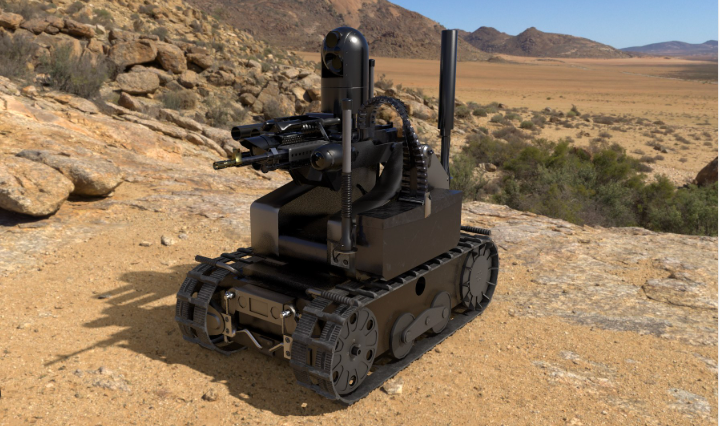
2 MAARS Armed Robotic System
The Modular Advanced Armed Robotic System, commonly known as MAARS, is a battlefield robot designed to extend the reach and capability of ground forces while reducing direct human exposure to danger. Developed as a next-generation unmanned ground vehicle, MAARS is essentially a compact robotic platform capable of both reconnaissance and direct combat support. It represents the growing integration of autonomous systems into modern warfare, where machines are increasingly used to perform high-risk tasks.
MAARS is designed with modularity in mind, meaning its configuration can be adjusted depending on mission requirements. It can be equipped with surveillance tools for scouting and target identification or fitted with weapon systems for direct engagement. Its standard armament includes an M240B machine gun and grenade launchers, giving it significant firepower for its size. This allows it to provide suppressive fire, defend positions, or engage targets while operators remain at a safe distance.
One of the key advantages of MAARS is its remote operation capability. Soldiers can control the system from a protected location, using a control interface similar to advanced gaming systems but designed for military precision. This separation between operator and battlefield reduces casualties and allows for safer reconnaissance in hostile environments. The system can also transmit real-time video and sensor data, improving situational awareness for ground units.
The robot’s mobility is another critical feature. Built on a tracked chassis, MAARS can navigate rough terrain, rubble, and urban environments where traditional vehicles may struggle. This makes it particularly useful in close-quarters combat scenarios such as city warfare, where visibility is limited and threats can emerge from multiple directions.
Despite its advantages, MAARS also highlights the increasing complexity of modern warfare. While it reduces risk to human soldiers, it introduces new challenges in control, decision-making, and ethical considerations regarding the use of armed autonomous systems. Nevertheless, it remains a significant step toward integrating robotics into frontline military operations.