

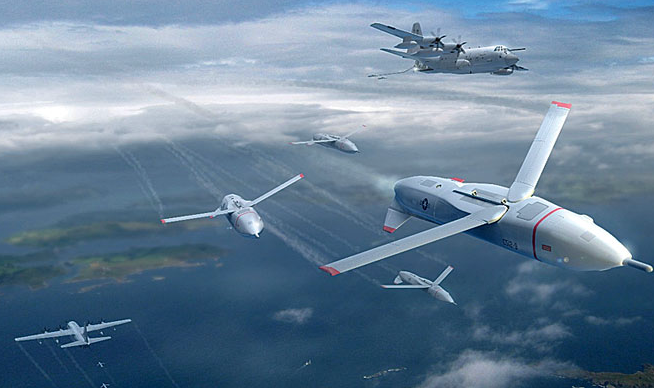
4 Swarm Drone Systems
Swarm drone technology represents one of the most transformative developments in modern military warfare, focusing on the idea that large numbers of small, coordinated unmanned aerial vehicles can achieve effects that once required far larger and more expensive platforms. Rather than relying on a single advanced aircraft, swarm systems use dozens or even hundreds of micro-drones that operate together, sharing data, adapting to conditions, and overwhelming enemy defenses through sheer scale and coordination. This concept is heavily influenced by biological systems, especially swarms of insects or flocks of birds, where collective behavior creates intelligence beyond the individual unit.
Each drone in a swarm is typically small, lightweight, and relatively inexpensive. Individually, they carry limited capability, but when networked together, they become a powerful distributed system. These drones can perform surveillance, reconnaissance, electronic disruption, and even coordinated attack roles depending on their configuration. The key strength lies in their ability to act as a unified force, dynamically adjusting flight paths, splitting into sub-groups, or converging on targets based on real-time data.
One of the most important advantages of swarm systems is their resilience. Unlike traditional aircraft, which rely on the survival of a single high-value platform, swarms can continue functioning even after losing multiple units. If some drones are destroyed or jammed, the remaining units can still complete the mission. This makes them particularly difficult for traditional air defense systems to counter effectively, as they must track and engage multiple small targets simultaneously.
Swarm drones also introduce a new level of situational awareness on the battlefield. Equipped with cameras and sensors, they can map environments, identify threats, and transmit real-time intelligence back to operators. This allows military forces to see through complex environments such as urban terrain or heavily defended zones without risking manned aircraft or ground troops.
Despite their potential, swarm systems also raise technical challenges, particularly in communication, coordination, and resistance to electronic warfare. Maintaining stable links between large numbers of drones in contested environments is complex. However, continued development suggests that swarm technology will play an increasingly central role in future military operations, redefining how air power is deployed.