

Modern military power is defined not just by size, but by the level of technology, precision, and strategic capability built into its weapons systems. The United States military stands at the top of this evolution, fielding platforms across air, land, sea, and space that combine advanced engineering with real-world combat effectiveness. From stealth aircraft and hypersonic missiles to armored vehicles and autonomous systems, each weapon reflects decades of innovation shaped by changing warfare demands. The toughest and most sophisticated weapons developed by the U.S. military. It brings together systems that represent different branches and roles, showing how modern warfare is no longer limited to a single domain but operates as a fully integrated network of power, speed, and intelligence.
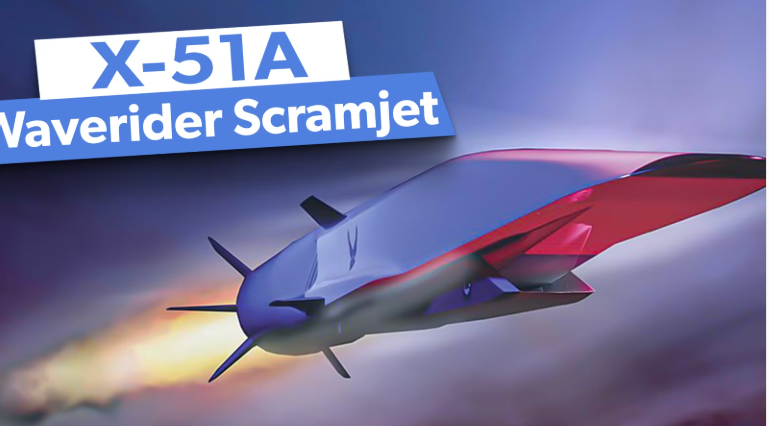
1 X-51A Waverider Hypersonic Missile
The X-51A Waverider represents one of the most advanced experimental missile systems ever developed by the United States military, designed to operate at hypersonic speeds that push the limits of modern aerodynamics and propulsion. Unlike traditional cruise missiles that rely on rocket engines for sustained flight, the Waverider uses a scramjet engine, allowing it to “ride” its own shockwave through the atmosphere. This method of propulsion enables it to achieve speeds far beyond Mach 5, placing it firmly in the hypersonic category where conventional air defenses struggle to track or intercept it effectively.
The core concept behind the Waverider is its ability to compress incoming air through its shape and forward motion, using that compression to sustain combustion at extremely high speeds. This makes it fundamentally different from earlier missile designs. The airframe itself is shaped to optimize shockwave behavior, allowing the missile to generate lift and stability while traveling at extreme velocities. This creates a unique advantage in terms of speed and unpredictability, as the weapon can theoretically strike targets across vast distances in a very short time frame.
One of the most significant implications of this system is its potential global strike capability. In theory, a hypersonic vehicle like the X-51A could reach almost any point on Earth within an hour, drastically reducing the reaction time available to enemy defenses. This compresses the entire engagement cycle, making traditional early warning systems less effective. The missile essentially transforms distance into a minimal barrier, changing how strategic planners think about deterrence and response.
However, the X-51A remains experimental, and its development highlights the challenges of sustained hypersonic flight. At such speeds, heat generation becomes extreme, placing immense stress on materials and structural integrity. Maintaining stable combustion inside a scramjet engine under these conditions is one of the most complex engineering problems in aerospace technology. Despite these challenges, successful test flights have demonstrated the feasibility of hypersonic cruise propulsion.
The Waverider program also represents a broader shift in military thinking, where speed is becoming as important as stealth or firepower. Instead of relying solely on evasion or armor penetration, future weapons may prioritize overwhelming reaction time itself. In that sense, the X-51A is not just a missile but a technological demonstration of a new era in warfare.